You're Not Crazy
You searched "is my husband a narcissist," and you found a thousand voices telling you the answer is yes.
We're not here to give you a different answer. We're here to ask whether the question might be more complicated than it looks.
What you're seeing is real. What it means might be different than what you've been told.
What You're Seeing Is Real
We're not going to start by defending him. We're going to start by acknowledging you.
The eggshells you've been walking on — those are real. The conversations that go nowhere, or worse, go somewhere that makes you apologize for bringing it up — those are real. The exhaustion of trying to reach a man who seems to be standing just out of reach — that is real, and it's not in your head, and you're not imagining it, and you're not too sensitive.
The behaviors you're seeing are very likely areas where he genuinely needs to grow. The withdrawal, the defensiveness, the inability to hear you, the way he turns things around so you end up being the problem — those patterns are doing real damage, and we don't minimize that. Whatever is driving them, the effect on you is the same, and you're not wrong to be hurting.
What we want to offer is not a different diagnosis, but a fuller picture, because what we've found, working with men who are standing where your husband is standing, is that the same behaviors can come from very different places, and the place they come from changes everything about what happens next.
How It Lands On Him
Here's something almost none of the narcissism content talks about: men also need and want emotional safety. We know that might sound strange when the man you're living with doesn't feel safe to you at all, but it's true, and it's actually central to understanding what's happening between you.
In a man's world, anything that suggests he's incompetent — as a partner, as a protector, as someone who should be able to handle things — hits a set of triggers that most women don't know exist, because men don't talk about them. But they're there, and they're deep, and when they get hit, something shifts inside him that makes it nearly impossible for him to hear what you're actually saying.
We find that most women, no matter how carefully they try, no matter how much care they put into the words, end up expressing what they need in a way that places him on the back foot. Not because she's doing it wrong, but because the territory is mined, and almost any approach can land as "you're failing," even when what she's really saying is "I'm hurting and I need you."
When a man feels that hit, he moves from feeling safe to feeling small, and from feeling small, he can't hear you anymore. Not won't. Can't. The walls go up, the defenses engage, and everything you say from that point forward gets processed through a filter that says "I'm being attacked," not "she's trying to reach me." What you experience as stonewalling, dismissal, or deflection is often what it looks like when a man has been moved from a place where he could hear you to a place where he physically can't.
That doesn't excuse the behavior. It doesn't make it okay. But it might explain why the same conversation keeps happening over and over, why your attempts to reach him keep hitting the same wall, and why nothing you say seems to get through. It's not that he doesn't care, it's that the way it's landing is moving him somewhere he can't respond from, and neither of you knows how to stop that cycle.
The Difference That Matters
Here's the distinction we want you to hold in your hands as you read everything, including this page: a narcissist is a person whose core structure is built around self-protection at the expense of others, and who has no genuine capacity for empathy or change. That person exists, and if that's who you're married to, the experts are right, and you need to protect yourself.
But a reactive man is something different. A reactive man is someone who, under chronic stress, disconnection, or fear, has retreated into defended behavior that looks narcissistic — the dismissiveness, the stonewalling, the need to be right, the inability to hear you without deflecting — but that isn't coming from a fixed personality structure. It's coming from a man who has lost his emotional footing and is operating from survival mode, and survival mode in an exhausted man looks a lot like narcissism from the outside.
The difference matters because a narcissist won't change, and a reactive man can. Not because he wants to, necessarily, but because the right frame, the right mirror, and the right challenge can reach something that's still alive underneath the armor. We've seen it happen. Not every time, and not with every man, but enough times to know that the label, when it's wrong, is one of the most expensive mistakes a family can make.
Part Eight of Narcissist! Or Not? is written directly for you — five chapters about guarding your heart, supporting growth without becoming his therapist, rebuilding trust, and twenty things he wishes you knew about him. It was written because we believe you deserve to make this decision with the fullest picture possible, not just the one the algorithm feeds you.
A Balanced Reading List
Read the experts. Read the counter-perspective. Then decide. These are the books we'd put in your hands, starting with the ones that validate your experience and ending with the one that might change his.
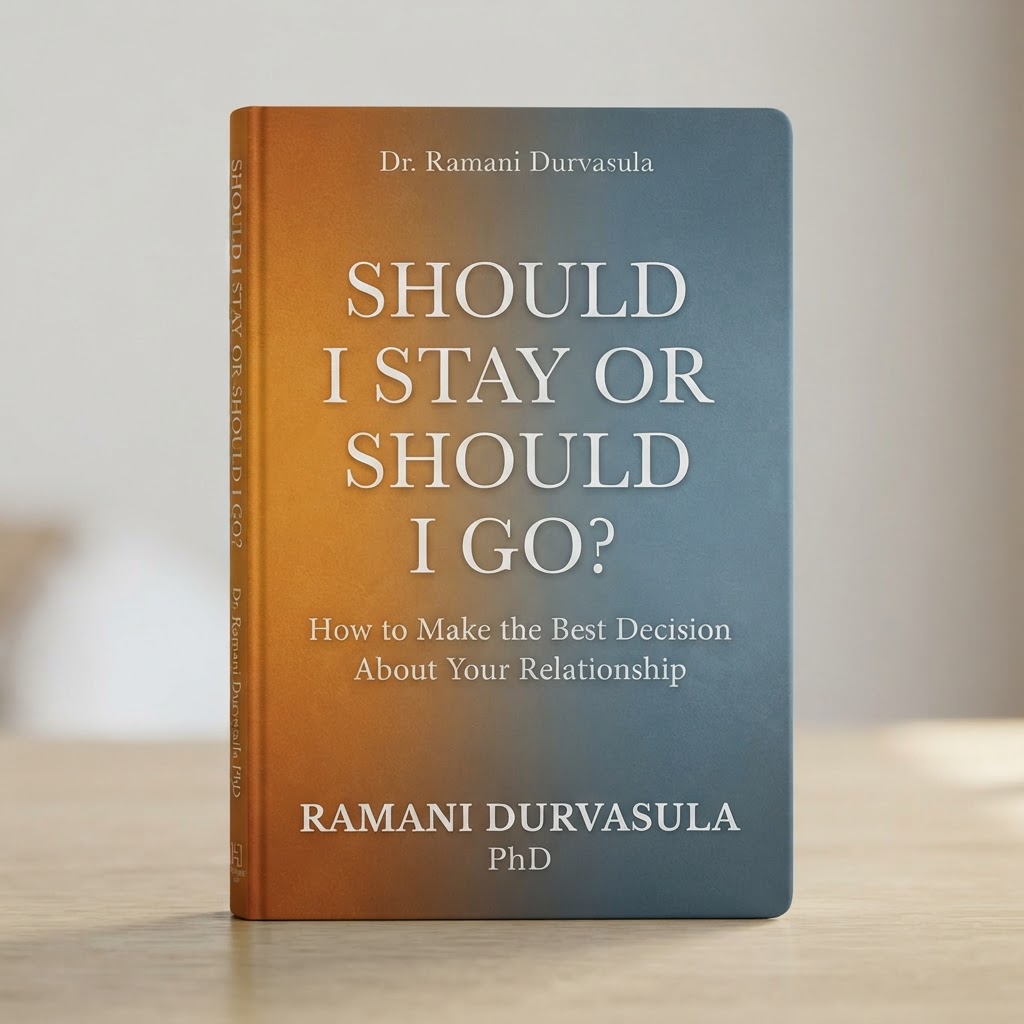
Should I Stay or Should I Go?
by Dr. Ramani Durvasula
A guide for women trying to decide whether to stay in or leave a relationship with a man they believe is narcissistic. It validates the exhaustion of loving someone who seems unable to love them back, and offers a framework for evaluating whether the relationship can be saved. For a woman who's been spiraling in confusion, the book offers something she desperately needs: permission to name what she's experiencing. But the framework assumes the man is the problem, and once she's looking through that lens, every withdrawn silence and defensive reaction confirms the diagnosis, because the book wasn't written to ask whether the man she's describing might be reactive rather than disordered.
Learn more →
It's Not You
by Dr. Ramani Durvasula
A confirmation for women that the confusion and self-doubt they feel in a difficult relationship is not their fault. It's deeply compassionate toward the reader, and for a woman who has been told she's crazy, too sensitive, or imagining things, that validation can be lifesaving. The book's title is its thesis: the problem is him, not you. That message is healing for someone who has been genuinely gaslit, but it also means that once she accepts it, your perspective, your exhaustion, your own pain stops being relevant to the conversation, because the book has already decided where the problem lives.
Learn more →
The Human Magnet Syndrome
by Ross Rosenberg
Explains why certain personalities attract each other, specifically how a self-sacrificing people-pleaser and a self-focused partner get locked into a cycle that feels like love but functions like addiction. For a woman who has spent years over-giving and getting little back, this book explains why she stays, which feels like an answer to a question she's been asking herself for a long time. The risk is that the framework is binary, you're either the empath or the narcissist, and if she identifies as the empath, then you, by definition, are the narcissist, and there's not much room for the possibility that you're both carrying something neither of you knows how to name.
Learn more →
Becoming the Narcissist's Nightmare
by Shahida Arabi
A survival guide focused on protecting yourself from a partner who shows no willingness to change. It's written for women in deeply harmful relationships, and for someone in that situation, the strategies it offers are practical and necessary. The book assumes the man is a predator, and for women who are living with one, that assumption is correct and the content saves lives. But the framework doesn't distinguish between a man who is exploiting her and a man who is simply lost, defended, and reacting badly to his own pain, and when it's applied to the latter, it treats a solvable problem like an unsolvable one.
Learn more →
In Sheep's Clothing
by George K. Simon
A guide to recognizing covert manipulation tactics, the subtle ways someone can control another person without appearing to. It gives women language for behaviors that felt wrong but were hard to name, and that clarity can be a relief after years of feeling like something was off without being able to explain it. The book is clinical in tone, which gives it authority, and that authority means the patterns it describes can start showing up everywhere once she's learned to see them, including in a man who is withdrawing not to manipulate her, but because he doesn't know what else to do.
Learn more →
Will I Ever Be Good Enough?
by Dr. Karyl McBride
Focused on daughters of narcissistic mothers, this book helps women understand how childhood patterns shape who they choose as partners and why they repeat familiar dynamics. For a woman who grew up never feeling like she was enough, the book offers a name for the ache she's carried her whole life, and that naming is real healing. But the framework can also become a lens through which every man who disappoints her starts to look like her mother, and if you're the man she's looking at, that means her interpretation of your behavior is being shaped by a pattern that started long before you were in the picture.
Learn more →
The Covert Passive-Aggressive Narcissist
by Debbie Mirza
A deep look at the quieter form of narcissism, the kind that hides behind niceness, withdrawal, and passive-aggressive patterns rather than grandiosity and bluster. For a woman whose partner doesn't fit the loud, confident narcissist stereotype but still leaves her feeling invisible and unimportant, this book explains what she's seeing, and that explanation can feel like finally being told the truth. The challenge is that the behaviors it describes, the shutting down, the not talking, the avoiding conflict, are also what a man does when he's overwhelmed, afraid, and has no tools for emotional expression, and the book doesn't draw a line between the two.
Learn more →
Rethinking Narcissism
by Dr. Craig Malkin
The most clinically balanced book on this list. Malkin argues that narcissism exists on a spectrum, that we all have some, and that the label has become so broad it's losing its meaning. For a woman reading this one, the nuance is actually helpful, because it resists the binary of narcissist or not, and acknowledges that people can have narcissistic traits without being permanently disordered. This is the book on the list that comes closest to asking the question this page is asking, and if she's read it, there's a good chance she's already holding a more complex view than the other books gave her.
Learn more →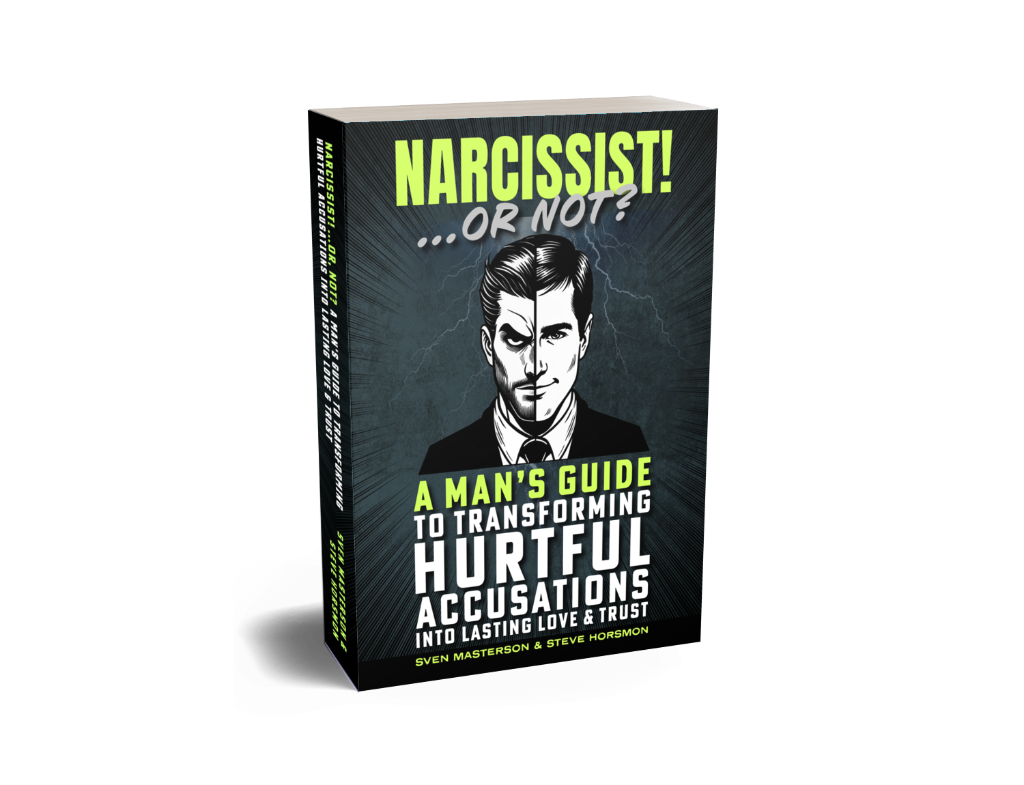
And one more — written to him.
Narcissist! Or Not? is the book that sits on the other side of the conversation. It doesn't ask you to tolerate harmful behavior. It asks him to look at himself honestly, understand what you're experiencing, and decide whether he's willing to do the work. If you're going to read everything else on this list, read this one too — not because it will make you stay, but because it will help you know whether staying is even a question.
Learn about the book →If You Decide to Stay
Staying is not weakness, and it's not codependency, and it's not you being fooled again. Staying, when it's a conscious choice made with open eyes and clear boundaries, can be one of the most courageous things you'll ever do. But it requires something that leaving doesn't: it requires that you hold two truths at once — that your experience is real and valid, and that his might be more complex than the label suggests.
If you stay, don't stay silently. Don't stay and absorb. Stay and require growth, because a man who is willing to look at himself honestly will become a different person, and a man who isn't will show you that soon enough. The book gives him a framework for that work, and it gives you a way to know whether he's actually doing it or just performing it.
And if you decide to go, go knowing you considered everything. Not because anyone asked you to, but because a decision made in full view is a decision you won't second-guess for the rest of your life.
If You're Ready to Look at Your Own Next Step
This page has been about understanding him, and that matters, but at some point the question shifts, and it becomes about you — not what he's doing or not doing, but what you need, what you want, and what you're ready for. If you've arrived at that point, we'd invite you to apply for a private call.
Apply for a Call →It's an application, not a guaranteed booking. We review every one personally, and we don't take everyone. If it's a fit, we'll reach out. If it's not, we'll tell you that too, and we'll point you toward what might help.
If your husband is the one who needs to do the work, and he's open to it, he can connect with us directly — we work with men who've been called what he's been called.